
Engineering
Why we chose LFP: lithium chemistries in plain language
Lithium iron phosphate vs. NMC: energy density, cycle life, safety, cold-weather behavior, and the trade-offs we accepted when we chose LFP for VoltPak.
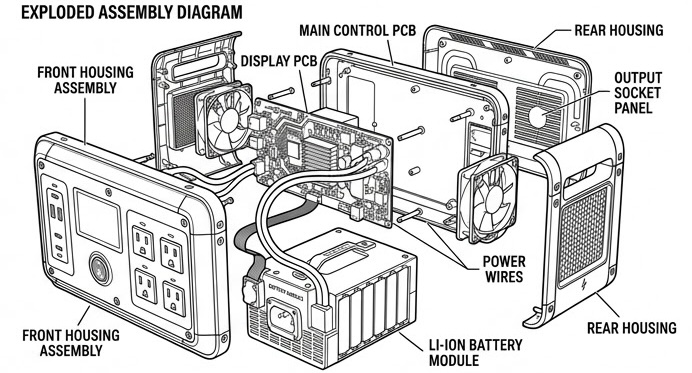
"Lithium battery" is a category, not a chemistry. The cells in your phone, an electric car, and a portable power station can be very different inside, and those differences decide how long the product lasts and how it fails. VoltPak uses lithium iron phosphate (LiFePO4, "LFP"). This post explains why, and what we gave up.
The two chemistries people compare
NMC (nickel manganese cobalt) is the chemistry behind most phones, laptops, and many electric vehicles. LFP swaps the nickel and cobalt cathode for iron and phosphate.
| LFP | NMC | |
|---|---|---|
| Nominal cell voltage | ~3.2 V | ~3.6–3.7 V |
| Energy density (cell level, typical) | Lower (roughly 90–160 Wh/kg) | Higher (roughly 150–250 Wh/kg) |
| Cycle life (typical, to 80%) | Thousands (often 3,000+) | Hundreds to ~1,500 |
| Thermal runaway onset | Higher temperature, less energetic | Lower temperature, more energetic |
| Charging in freezing temps | Not allowed without heating | Limited, but tolerated more |
| Cobalt / nickel | None | Yes |
These are broad, industry-typical ranges rather than VoltPak measurements. Individual cells vary a lot by manufacturer and grade.
Why LFP for a power station
1. It lasts longer under daily use
A power station is often cycled hard: solar every day, camping every weekend, or a nightly grid-tied schedule. Cycle life is the number that decides whether the product is still useful in ten years. LFP's typical cycle life is several times that of NMC, which is the single biggest reason we chose it.
2. It fails more gently
All lithium cells can be abused into thermal runaway. LFP's phosphate cathode is more stable: it releases far less oxygen when overheated, so it starts at a higher temperature and is less violent when it does. That doesn't make it a safety system on its own. We still rely on a multi-stage battery management system (BMS) with cell-level monitoring, fusing, and temperature sensing, but it gives that system more margin.
No lithium battery is risk-free. Use a unit only within its rated temperature range, don't use damaged packs, and keep it ventilated.
3. It tolerates being full
NMC cells age faster when parked at 100%. LFP is comfortable at high state of charge, which suits a power station that lives on a charger waiting for an outage.
4. No cobalt or nickel
Cobalt and nickel are among the most environmentally and socially costly materials in battery supply chains. Iron and phosphate are abundant and cheap. This is a real advantage, though not a complete sustainability story on its own.
What LFP costs us
We'd rather be plain about the trade-offs:
- Weight and size. Lower energy density means more cells for the same Wh. It's a big part of why a 1 kWh-class LFP unit is a "carry it with both hands" product, not a pocketable one.
- Cold charging. Charging LFP below about 0 °C (32 °F) can cause lithium plating and permanent damage. A unit either needs pack heating or must refuse to charge when cold. Discharging in the cold works but delivers less capacity.
- Flat voltage curve. LFP's voltage barely changes between about 20% and 90% charge, so estimating state of charge from voltage alone is unreliable. Good coulomb counting and periodic recalibration in the BMS matter more than with NMC.
How the numbers work out on the VoltPak 1000
Our design uses eight cells in series (8S), which gives a nominal pack voltage of 8 × 3.2 V = 25.6 V. Design capacity is 1,024 Wh, which is 25.6 V × 40 Ah. Those are design figures for the pre-production unit and will be confirmed with measured data at launch.
The practical guidance
- Store LFP packs at a partial-to-full charge, and top up at least every few months.
- Don't charge below freezing; let the pack warm up first.
- Don't leave a pack fully discharged for long periods. It can drift out of balance.
Related reading: how to size a power station for home backup and our battery health guide.